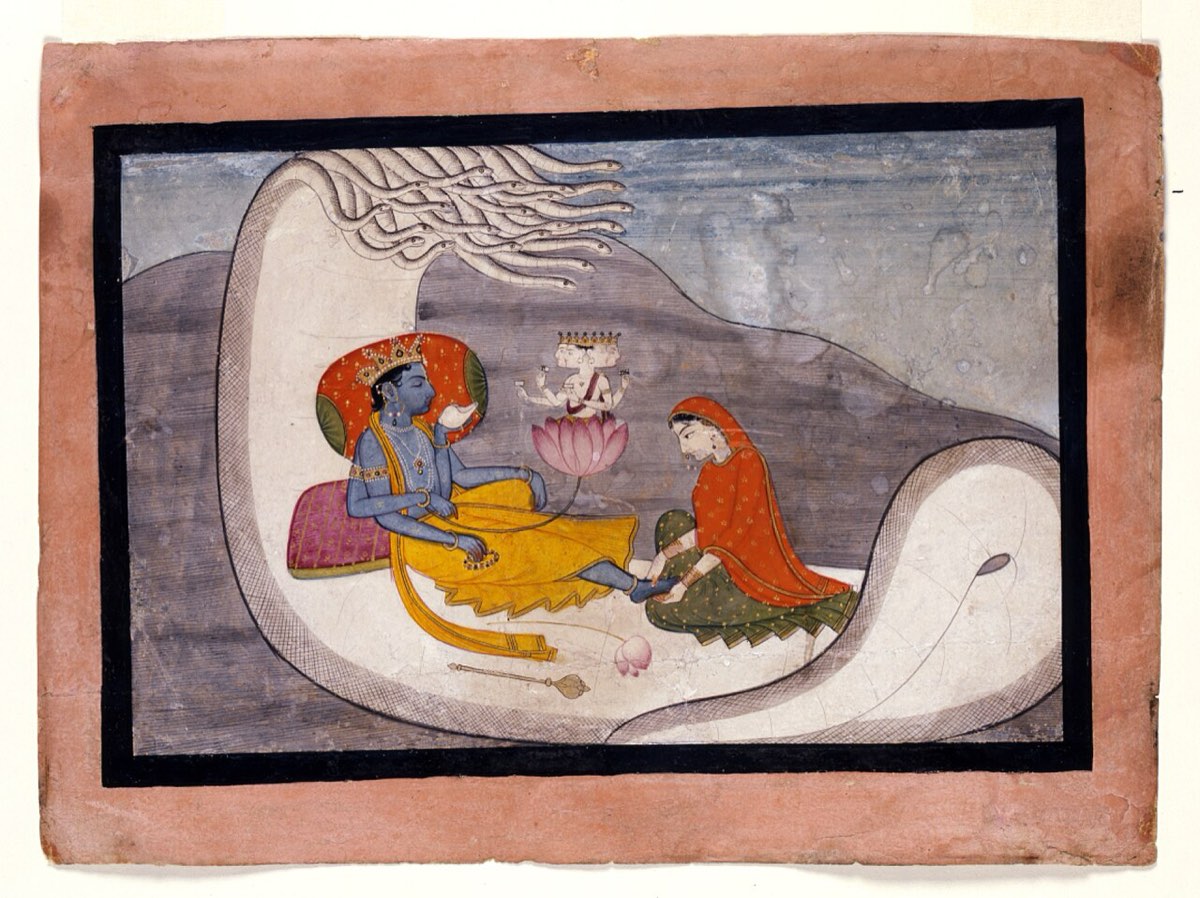
Quantum physics and Vedanta: where the analogies help and where they mislead
Entanglement, the observer and Maya are the most cited parallels between quantum physics and Vedanta; a close look shows what holds up and what is extrapolation.
· 5 min read · Sources
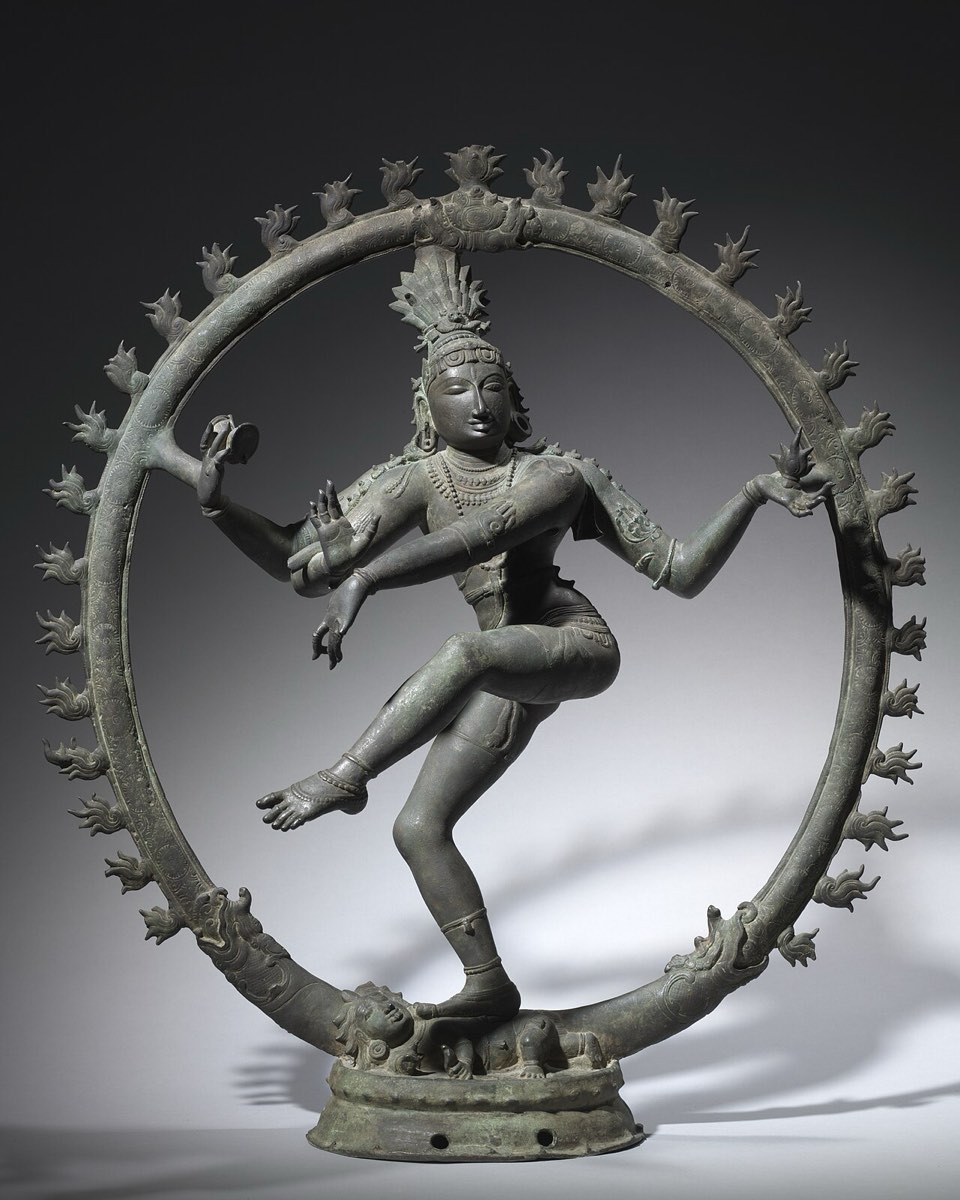

In 1 minute
- Pioneers of quantum physics, such as Schrödinger and Heisenberg, took an interest in Indian thought, but out of philosophical affinity, not by incorporating it into the theory.
- The most cited parallels, between entanglement and the unity of Brahman or between wave-function collapse and Maya, run into differences of scale, definition and purpose.
- Critics call for caution against so-called quantum mysticism, and the conclusion is that the dialogue is worthwhile as inspiration, not as proof of one side over the other.
Full article
Few ideas in science stir as much desire for reconciliation with spirituality as quantum physics. Particles that seem to be in two states at once, measurements that alter what they measure, distant objects that behave as one: all of it sounds familiar to anyone who has studied the Indian tradition, in which the manifold world would be the manifestation of a single reality. Vedanta, one of the six classical schools of Indian philosophy, is the most frequent interlocutor in this conversation.
The question is how far the comparison holds up. To answer it, it helps to lay out each side in its own terms, look at the most cited parallels, and weigh what the critics say.
What quantum physics describes
Quantum mechanics was born at the start of the twentieth century. In 1900, Max Planck proposed that energy is exchanged in discrete packets, quanta. In 1924, Louis de Broglie suggested that all matter behaves sometimes as a particle, sometimes as a wave. In 1927, Werner Heisenberg formulated the uncertainty principle: certain pairs of properties, such as position and velocity, cannot be known at the same time with unlimited precision, and this reflects the nature of the atomic world, not a flaw in the instruments.
Before a measurement, a system can exist as a combination of possible states, superposition. Two particles can also become entangled, so that the state of one cannot be described without the other's, even at a distance. Einstein called this "spooky action at a distance" and, in 1935, with Podolsky and Rosen, argued that the theory must be incomplete. Experiments by John Clauser, Alain Aspect and Anton Zeilinger, awarded the 2022 Nobel Prize in Physics, showed that local hidden variables, as Einstein imagined them, do not explain the results.
That does not settle the philosophical debate. One cannot hold at the same time that properties exist before measurement and that no influence travels faster than light, and physicists disagree about which of the two ideas to give up.
What Vedanta claims
Vedanta means "the end of the Vedas." It rests on the Upanishads, the Brahma Sutras and the Bhagavad Gītā. The school most invoked in these comparisons is Advaita, or non-dualism, associated with Adi Shankaracharya.
In it, Brahman is ultimate reality, described as existence, consciousness and fullness. Ātman is the inner self, and the central thesis is that it is identical to Brahman, which the tradition sums up in the formula "Thou art That." Māyā is the power that veils that unity and projects the world of diversity. The classic image is that of a rope mistaken for a snake in dim light: when the light of knowledge arrives, the snake disappears.
Māyā is usually translated as illusion, but Shankara distinguishes levels. The everyday world has practical validity, even though it is dependent and impermanent before Brahman. The goal of Vedanta is not to describe the universe. It is liberation, moksha, through direct knowledge of the identity between the self and the absolute.
The most cited parallels
The first compares entanglement to the unity of Brahman. Both challenge the idea of a world made of isolated pieces. Critics respond that entanglement is a microscopic phenomenon, described by correlations between systems that shared a history, while Vedantic unity is a claim about being, with no relation of parts.
The second associates the observer effect with Māyā. In physics, "observer" is usually an apparatus that interacts with the system, not a mind. In Māyā, by contrast, what dissolves is ignorance, and the instrument is self-knowledge, not a measurement.
The third links consciousness to the collapse of the wave function. Von Neumann, Wigner and, more recently, Amit Goswami argued that consciousness would play a causal role. That is a minority, speculative position that most physicists do not accept. And Vedanta speaks of an absolute consciousness, not the individual mind of whoever performs the experiment.
Other pairs have been suggested: wave-particle duality and the paradoxical nature of Brahman, the quantum vacuum and Brahman as pure potentiality. In all of them, the same pattern repeats. The similarity of language exists; the equivalence of meaning does not.
How the comparison arose and who criticizes it
The interest is old and comes from within physics itself. Schrödinger often referred to the Upanishads, and Heisenberg said he found comfort in Indian thought. That indicates personal affinity, not the entry of Vedic concepts into the theory. Marcia Tiemi Saito's thesis on quantum mysticism points further to a cultural backdrop that includes Neo-Romanticism, Weimar Germany, the counterculture of the 1970s and the New Age. Osvaldo Pessoa Jr. notes that the theory's minimal formalism leaves the nature of measurement open, and that gap left room for idealist interpretations.
Popularization came with The Tao of Physics, by Fritjof Capra, who argued for a deep harmony between science and mystical tradition, and with the books by Goswami, who proposes a universe whose basis would be consciousness. On the other side, Pessoa Jr. disputes that the theory implies idealism and calls claims that the human mind alters quantum probabilities pseudoscientific. Critics of Capra note that the strangeness of the atomic world cannot simply be scaled up to everyday life. The Regional Council of Psychology of São Paulo, for its part, warns against mixing science and religion in professional practice.
Three underlying differences
The first is the source of knowledge. Physics validates its theories through observation, experiment and the possibility of refutation, and holds them as provisional. Vedanta rests on revealed scripture, on logic within its own system, on the testimony of sages, and on the direct experience resulting from practice.
The second is the direction of the gaze. Science seeks knowledge of the outer world, even though quantum physics has complicated the idea of naive objectivity. Vedanta investigates the knowing subject.
The third is purpose. Physics wants to describe and predict phenomena. Vedanta wants to free one from the suffering caused by ignorance about who we are.
What remains
The possible conclusion is a balanced one. There are real thematic resonances: both traditions reject the image of a reality made of separate objects, independent of whoever observes them. But equating entanglement with Brahman, or collapse with Māyā, tends to produce simplification and extrapolation. Physics does not prove Vedanta, nor does Vedanta offer a shortcut to physics.
The value of the dialogue lies in inspiring questions, not in supplying ready-made answers. And it may say more about the one asking than about the atom: in a world increasingly fragmented by specialization, the desire to see unity is, itself, a fact worth examining.
Sources and references for this article
Vedanta, WikipediaFundamental principles of quantum mechanics, Anais do IFCVedanta, Editora VedantaThe formula of entanglement, Revista Pesquisa FapespObserver effect (physics), WikipediaTranslated from Portuguese. This article was rewritten from a post on the original blog, in Portuguese. Read the original
Read next
 Science and consciousnessThe pineal gland: what science knows, and what “unblocking” it doesn't support
 Science and consciousnessWhat the studies show about Ashtanga Yoga, from the heart to the bones
 Vedanta and Yoga · VideoWhat is consciousness? Vedanta faces off with neuroscience, physics, and AI
 Vedanta and Yoga · VideoDoes God sleep? What Advaita Vedānta says about the consciousness that never sleeps
 Vedanta and Yoga · VideoIs the universe real? Advaita Vedānta's three answers, from creation to "never born"