Nag Hammadi: the 1945 jar that revealed a Christianity in dispute
Thirteen codices found by peasants in Egypt in 1945 gave the Gnostics a direct voice and showed how plural early Christianity was.
· 5 min read · Sources

In 1 minute
- In December 1945, peasants in Upper Egypt found a jar containing thirteen papyrus codices gathering 52 treatises, many unknown until then.
- The texts, copied in Coptic around the 4th century, made it possible to study the Gnostics in their own words, not only through their opponents.
- For many scholars, the collection suggests that the first Christian centuries held several currents in dispute, and that orthodoxy took shape gradually.
Full article
In December 1945, near the town of Nag Hammadi in Upper Egypt, the peasant Muhammad Ali al-Samman and his brothers were digging for sabakh, a nitrate-rich soil used as fertilizer. Their hoe struck a terracotta jar about a meter tall, sealed with a bowl. Muhammad Ali told the scholar James M. Robinson decades later that he hesitated to break it, afraid it might hold a jinn, a spirit from Arab folklore. The hope of finding gold won out over the fear. Inside were thirteen papyrus books.
Those volumes, the Nag Hammadi codices, gather 52 treatises, six of which are repeats, leaving 46 distinct works. About 41 were unknown to modern scholars. Many had existed only as names cited by authors who opposed them. The find is often compared to the Dead Sea Scrolls, made around the same time.
A library in Coptic
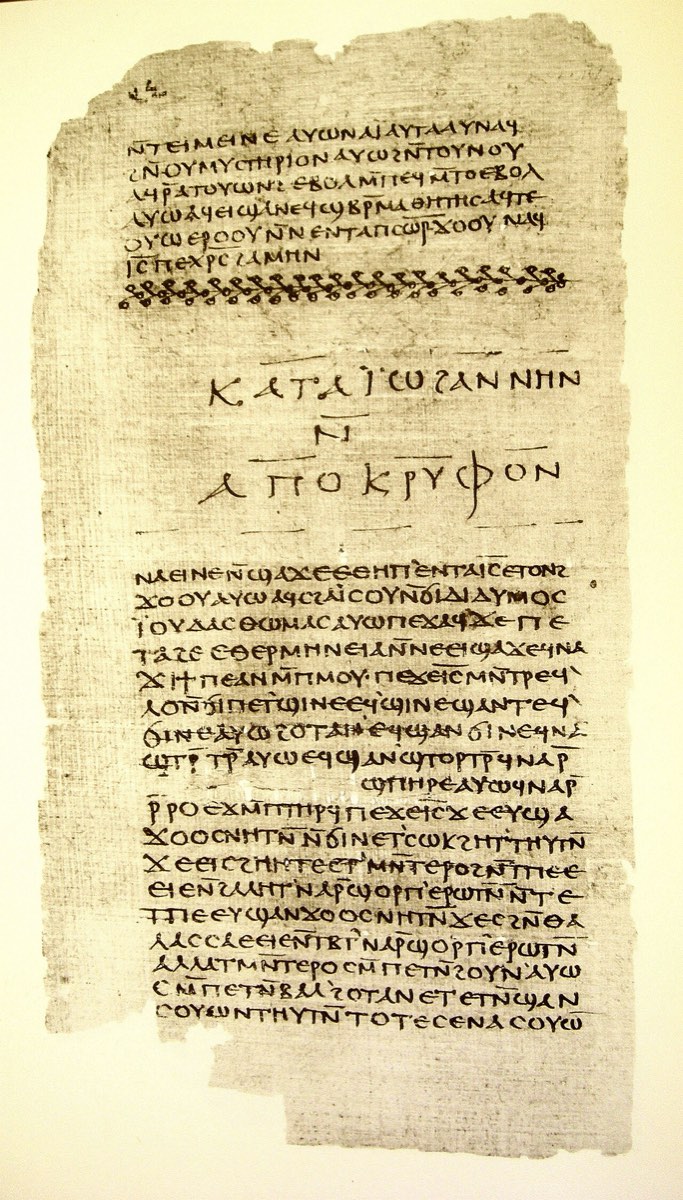
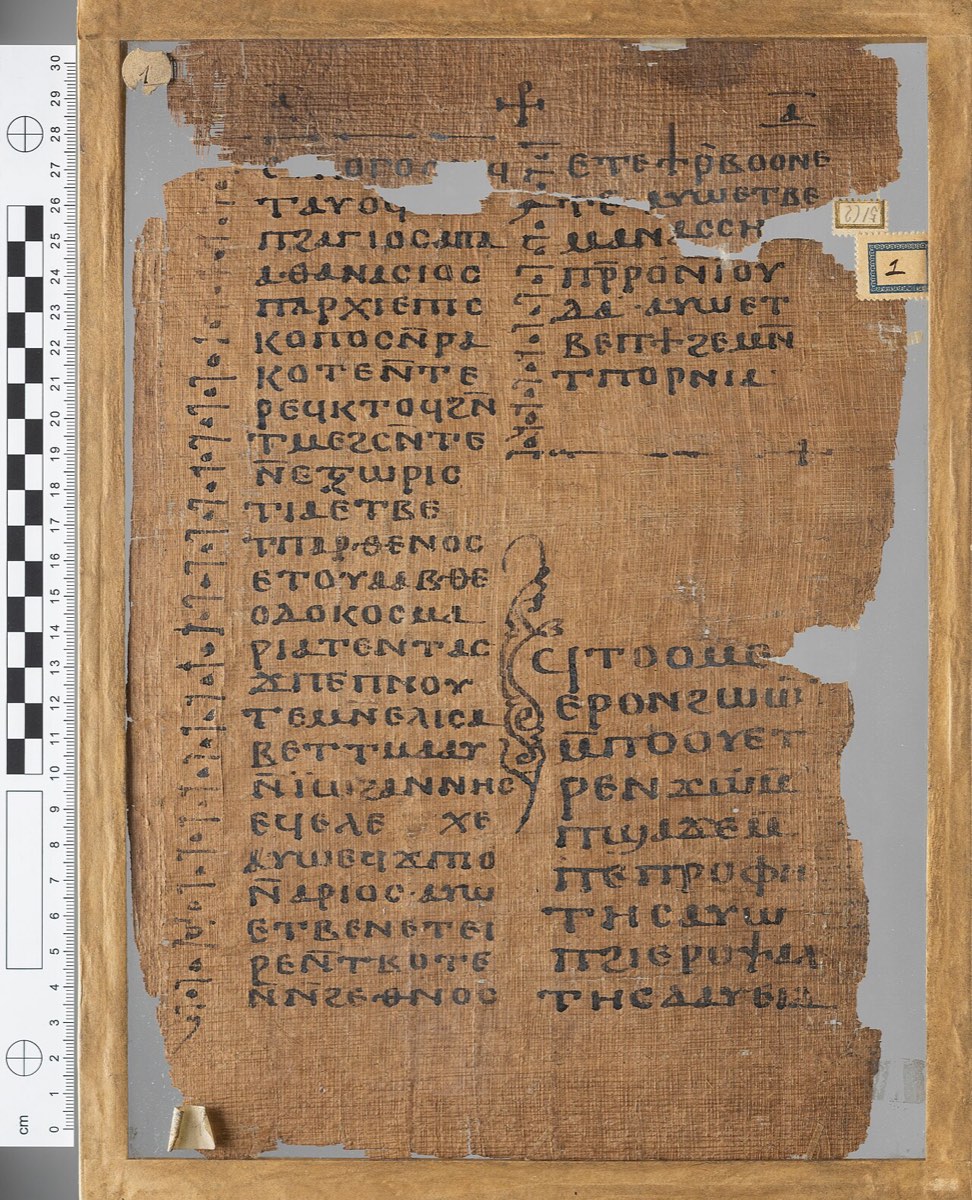
The codices are books of papyrus pages stitched together and bound in leather, a form that by then had replaced the scroll. The texts are in Coptic, the last stage of the Egyptian language, written with the Greek alphabet plus a few extra signs. Most scholars understand them as translations of Greek originals from the 2nd and 3rd centuries. The copies date from the mid-4th century. The dating rests on the style of the handwriting and on scraps of papyrus reused in the covers, some bearing receipts dated 341, 346, and 348.
The content is varied. There are gospels, apocalypses, letters attributed to apostles, prayers, hymns, sermons, and philosophical treatises. Among them are the Gospel of Thomas and the Secret Book of John. There are also writings from Hermetism, a current of texts attributed to Hermes Trismegistus, and even an excerpt from Plato's Republic. A collection like this suggests curious readers, not the closed canon of a single sect.
Some central texts
The Gospel of Thomas is a collection of 114 sayings attributed to Jesus, and the library holds its only complete copy. Some sayings have parallels in the New Testament gospels, others are unprecedented. There is no narrative of miracles, passion, or resurrection. Jesus appears as a teacher of wisdom, and salvation comes from understanding his sayings. The Kingdom, there, is present and must be discovered: “The Kingdom is inside you and outside you.” Most scholars date the text to the 2nd century, and some argue for an earlier origin.
The Gospel of Philip gathers sayings and reflections on rituals, and many link it to Valentinianism, a 2nd-century gnostic school. It speaks of an original unity lost with the separation of the sexes and of a sacrament called the “bridal chamber.” Mary Magdalene appears as the Savior's “companion.” The text says Jesus kissed her, and many scholars read the kiss as a symbol of the transmission of spiritual knowledge.
The Gospel of Truth, attributed to Valentinus or a disciple, is a poetic meditation on the Father and gnosis, the knowledge that saves, according to the Gnostics. Ignorance of the Father, personified as “Error,” would be the root of suffering. The crucifixion is read symbolically: Christ becomes the fruit of knowledge of the Father.
The Hypostasis of the Archons is a gnostic reading of the opening chapters of Genesis, probably from the 3rd century. The archons, or rulers, are cosmic powers. Their chief, Yaldabaoth, is the result of an error by Sophia, the divine Wisdom. Ignorant and arrogant, he fabricates the material world and declares himself the only God. Humanity, though shaped by them, carries a spark of the higher spirit. In other gnostic texts, the serpent of Eden even becomes a revealer of knowledge. These works do not ignore the Bible: they reinterpret it, and sometimes turn it inside out.
Why someone buried the books
The most accepted hypothesis is that the codices were hidden on purpose. The likely trigger would be the Easter letter of Athanasius, bishop of Alexandria, in 367. It gives the earliest known list of the 27 books of today's New Testament and condemns other writings as apocryphal, secret, or heretical, asking monasteries to remove them from their libraries.
The site lies near monasteries founded by Pachomius, and the codices' covers were reinforced with papyri that mention monks and their activities. For that reason, scholars such as Robinson, and more recently Hugo Lundhaug and Lance Jenott, argue for a monastic origin. The monks might have read these texts for study, for refutation, or out of interest in the asceticism some of them advocate. Burying, rather than burning, suggests at least the hope of preserving them.
The road to the museums
The books' fate was accidental. Muhammad Ali's mother reportedly used papyrus leaves to light the oven, losing part of the material. Codices were sold for trivial sums or traded for cigarettes. A local teacher sent one to Cairo, and most ended up with the antiquities dealer Phokion J. Tanos. Egypt's Department of Antiquities stepped in, and after the 1952 revolution the codices were handed over to the Coptic Museum in Cairo, through the efforts of its director, Pahor Labib.
Codex I took a path of its own. Sold to a Belgian antiquarian, it was bought in 1951 by the Carl Gustav Jung Institute in Zurich as a gift to Jung, and became known as the Jung Codex. It only returned to Cairo in 1975, after disputes following the psychoanalyst's death in 1961.
The first translation appeared in 1956. Starting with the 1966 Messina congress, Robinson assembled a team that published a twelve-volume facsimile edition between 1972 and 1984. In 1978, The Nag Hammadi Library in English came out, later revised. Today the images and translations are also online.
What changed in scholarship
Before 1945, Gnosticism was known mainly through the writings of opponents such as Irenaeus of Lyon, Hippolytus of Rome, and Tertullian. Now the “heretics” could speak for themselves. For many researchers, the library also revealed a plural early Christianity, in which the line between orthodoxy and heresy was less sharp than previously assumed.
The debate remains open. Some scholars, such as Michael Allen Williams, argue that “Gnosticism” is a modern category, too generic to group together Sethian, Valentinian, Hermetic, and Platonic works, and that not all of them fight against the world or the Bible. Also still debated are the dating of the Greek originals, the relationship of some texts to the canonical gospels, and the purpose of the collection.
The differences from the New Testament appear at central points. In several Nag Hammadi texts, Jesus is above all one who reveals hidden knowledge, and salvation is liberation from ignorance. The New Testament emphasizes Jesus's death and resurrection and salvation through faith. Many gnostic cosmologies distinguish the world's creator from the supreme God. Christian tradition identifies the two.
A clay jar, buried by someone who preferred not to burn what he could no longer keep in sight, still raises uncomfortable questions: who decided what went into the Bible, and what was lost along the way.
Sources and references for this article
The Gnostic Discoveries: The Impact of the Nag Hammadi Library (Catholic Ireland)The Hypostasis of the Archons (Early Christian Writings)Hypostasis of the Archons (Fairfield University, PDF)The Hypostasis of the Archons, Wikipedia (in Portuguese)The Gospel of Truth, translated by Grant (Gnosis.org, Nag Hammadi Library)Translated from Portuguese. This article was rewritten from a post on the original blog, in Portuguese. Read the original
Read next
 Western esotericism · VideoWhat was Gnosticism: a dualist heresy, or a path of self-knowledge?
 Western esotericismGnosticism: the schools that saw the world as a prison and the creator as an impostor
 Vedanta and Yoga · VideoHow to live spiritually without leaving the world: what Vedānta answers
 Vedanta and YogaVedānta: texts, schools, and the study method of one of India's six philosophies
 Western esotericism · VideoThe Gospel of Mary: the ancient text in which Magdalene teaches and Peter doubts her