The Principle of Correspondence: why Hermeticism says life repeats its lessons
For Hermeticism, the same laws hold on every plane, from body to spirit, and life sends back unlearned lessons like letters that keep returning.
· 3 min read · Sources

In 1 minute
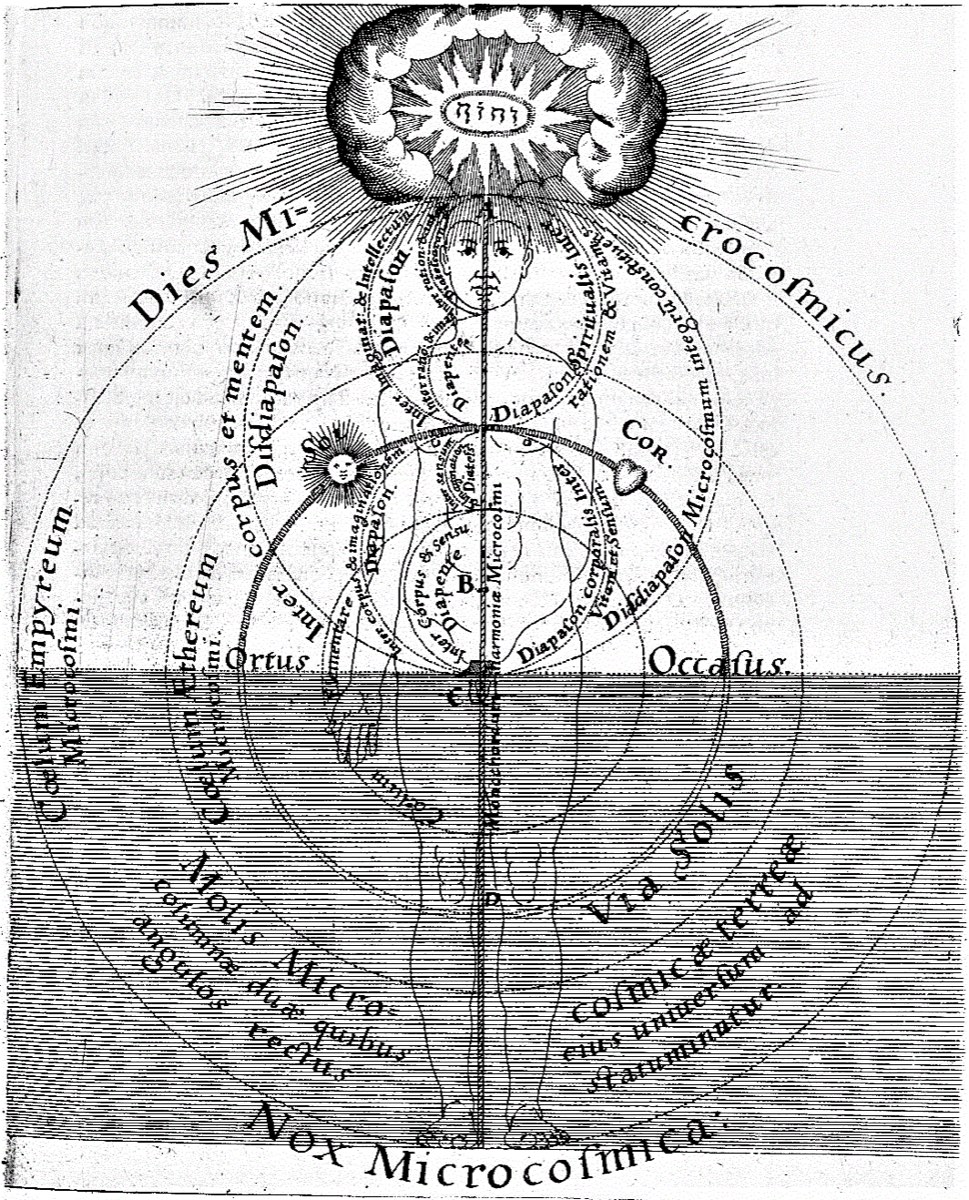
- The Principle of Correspondence states that harmony runs through every plane of existence: as above, so below.
- The tradition describes three planes (material, mental and spiritual), set apart by degree of vibration, and sees life repeating the same lesson until it is absorbed.
- Planes, elementals and masters are Hermetic concepts, presented as symbolic possibilities, not scientific findings.
Full article
One of Hermeticism's most repeated lines fits in a single sentence: "As above, so below; as below, so above." Repeated too often, it loses its weight. Philosophy schools such as Nova Acrópole, which teach the eighth chapter of The Kybalion, try to restore it by treating the line as the statement of the Principle of Correspondence.
The Kybalion, published in 1908 under the pseudonym "Three Initiates," gathers into seven principles the philosophy attributed to Hermes Trismegistus. The Principle of Correspondence holds that harmony runs through every plane of existence: from atom to star, from cell to spirit, the same laws would repeat at different scales. Planes, elementals and masters are concepts from the Hermetic tradition, not scientific findings.
The letter that comes back
The strongest image here is that of letters. Life sends the same message many times, but in different envelopes: a situation, a person, a pain, a challenge. As long as the letter goes unopened and the lesson unlearned, it keeps coming back.
Hence the warning that changing city, job or relationship solves little if the person stays the same. The letter's content follows whoever receives it. The question that remains is whether one opens the letters, or rejects the envelopes for their shape.
Three planes, one law
Drawing on Egyptian tradition, The Kybalion describes the universe in three planes. The material plane covers the body, the physical world and objects. The mental plane holds thoughts, emotions, desires and intentions. The spiritual plane keeps essence, soul and deeper purpose.
The planes are not set apart by distance but by degree of vibration, like frequencies occupying the same space. For the Egyptians, in the teachers' account, the location of a thing is vibrational, not spatial. Two people standing side by side can be thousands of miles apart in consciousness.
Cousteau's camera
To explain how consciousness travels across the planes, the tradition draws on the oceanographer Jacques Cousteau. The divine essence, the monad, would never have left the boat, that is, the spiritual plane. What descends into the depths of creation is consciousness, like a camera lowered into the sea.
In this reading, to evolve is to expand consciousness, not to change essence. It passes through the mineral, plant, animal and human kingdoms before reaching the spiritual, and each kingdom would be further divided into seven levels. The movement is described as a spiral: consciousness always returns to its point of origin, but with greater clarity.
Elementals and masters
Among the visible kingdoms, The Kybalion would place subtle kingdoms, the elementals. They are described as natural intelligences that help organize matter, life and consciousness, occupying the passages between mineral and plant, plant and animal, animal and human. Gnomes, fairies, undines and sylphs are names mythologies around the world have given them.
Masters, in turn, would be beings who have traveled every level of the mental plane and remain by choice, out of compassion, to guide those who come after. This is what the teachers call true fraternity: thinking as the ALL thinks, for the good of the whole.
Knowledge demands care
A warning comes with all this: no one is safe from losing their way, not even at spiritual levels, and error weighs more heavily the higher one has climbed. For that reason, self-knowledge would need to go hand in hand with ethics, fraternity and inner vigilance.
None of this, the teachers themselves caution, is offered as absolute truth. These are symbolic possibilities, which each person can live and test. The philosopher, they sum up, does not believe blindly, but also does not reject what they do not yet understand.
Reading life as symbol
If the laws are the same on every plane, and only degree of vibration and appearance change, every object, person or event can be read as the reflection of something greater. That is the principle's invitation: a life read the way one reads symbols. The next chapter of The Kybalion deals with the Principle of Vibration.
Sources and references for this article
Nova Acrópole lecture on the Kybalion, chapter 8
_The Kybalion_, chapter 8: The Principle of Correspondence
Kybalion, Wikipedia (published in 1908, and the seven principles)The Kybalion, Three Initiates, 1908 (full text in English, Project Gutenberg)Translated from Portuguese. This article was rewritten from a post on the original blog, in Portuguese. Read the original
Read next
 Western esotericism · VideoApocryphon of John: Barbelo, Sophia and the false god, in the Gnostic text from Nag Hammadi
 Western esotericism · VideoThe world as mistake and gnosis as the way out: the Gnostic cosmology of the archons
 Death and beyond · VideoA hereafter with no judge: Laércio Fonseca on the fate of consciousness after death
 The East · VideoŚūnyatā: what Nagarjuna meant by emptiness, and what it is not
 Western esotericism · VideoThe Kybalion and its seven principles: a 1908 book that speaks in Egypt's name