The Tripartite Tractate: how a gnostic text explains the Father, the fall, and the return
A Coptic gnostic text from Nag Hammadi, the Tripartite Tractate narrates the emanation of the All, the fall of a young aeon, and the final restoration.
· 5 min read · Sources

In 1 minute
- The Tripartite Tractate describes a Father with no origin, ineffable, who generates the Son, the Church, and the aeons out of generosity, not necessity.
- A young aeon tries to understand the Father before its time, and the failure produces ignorance, chaos, and beings who take themselves for gods, until the Savior intervenes.
- Humanity, formed of spirit, soul, and matter, is redeemed through knowledge and returns, restored, to the unity of the All.
Full article
A text more than 1,600 years old tries to answer, through a myth, a question philosophy still asks: if everything comes from a perfect principle, where do ignorance and suffering come from? The Tripartite Tractate, preserved in Coptic in the Nag Hammadi library, answers that they come from a flaw within the divine world itself, and that salvation is the path back.
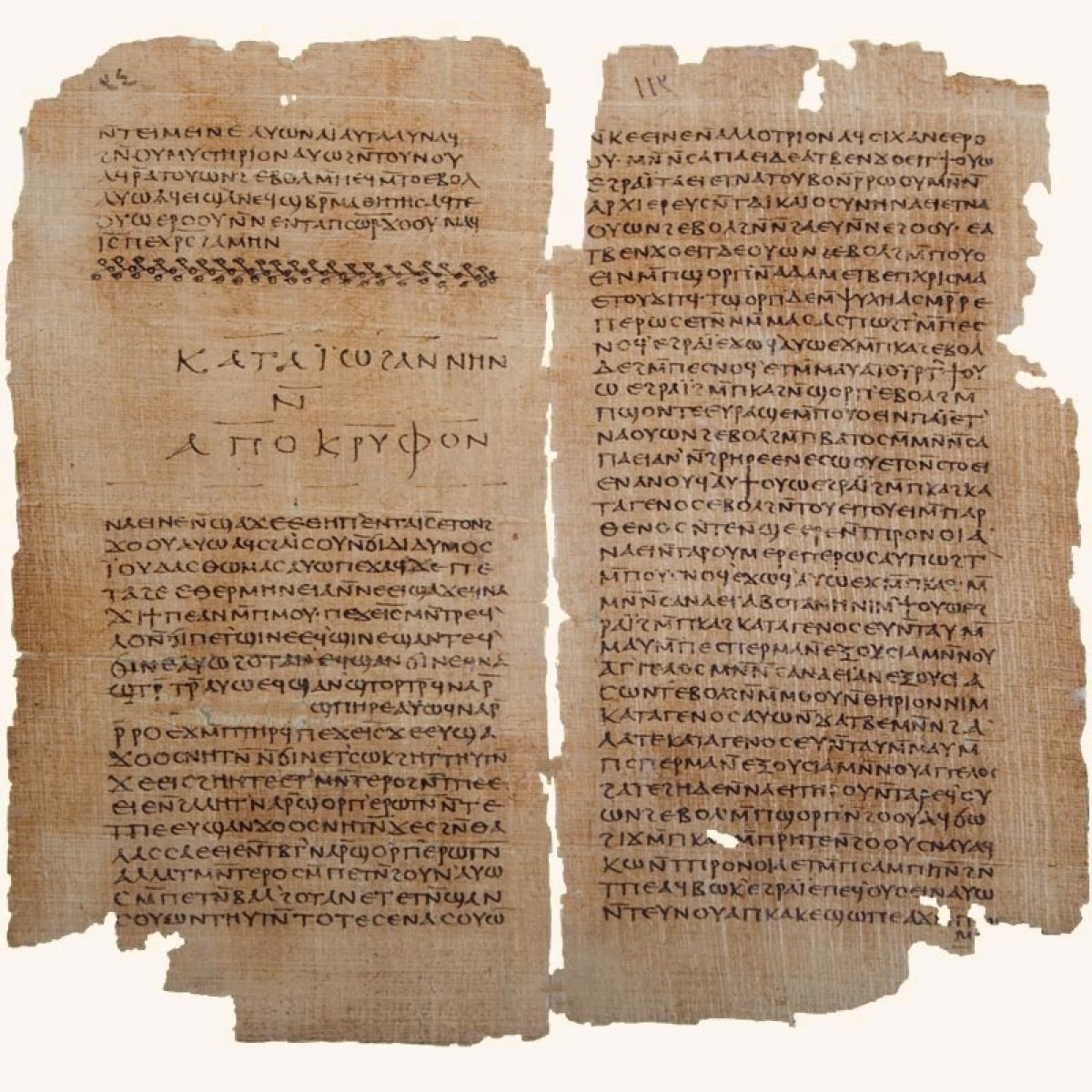
It is a gnostic work of Valentinian lineage, estimated to date from the second half of the 3rd century or the 4th century, possibly based on an older Greek original. It is the fifth tractate in the first Nag Hammadi codex, known as the Jung Codex, and the second longest in the collection. It has no ancient title: the name comes from the fact that the copyist divided the text into three parts, marked with decorative signs. The first describes the relationship among the Father, the Logos, the Church, and the aeons. The second brings the creation narrative, with the human being formed by the Demiurge, a mixture of spiritual and material substance. The third deals with the Savior's role. What follows walks through this sequence as the doctrine of an ancient school, read in its own terms, without taking it as historical fact.
The Father and the first emanation
The text opens by stating that one must acknowledge the primordial Father, the one true God. He has no origin, was not generated, and is unchanging and incomparable. Prior to creation, he is the source of all beings. His essence is ineffable: words, images, and human senses cannot reach it.
The Father generates the Son, but without dividing himself. It is a self-expression, an eternal reflection of himself. The Son appears through images such as the form of what has no form, the mind of the inconceivable, and the light of those he illuminates. The Church, in turn, would already exist in the Father's thought from eternity, as a community of divine beings.
Spiritual creation occurs out of generosity, not necessity. The Father emanates the All, which includes the aeons, eternal beings who reflect the Father's attributes and live in harmony, in multiplicity without separation. The text describes three acts of glorification: from the aeon to the Father, from the Father to the aeon, and from the aeon to itself and to others, by free will. These are creative acts, and plurality does not contradict unity, like branches still attached to the same root.
Knowing the Father in stages
Although inaccessible in essence, the Father lets himself be known in part through the Spirit, which plants the desire to seek him. This knowledge arrives in stages, so that no being considers itself equal to him. The tractate rejects the idea of an external God: the Father is reached through introspection and spiritual union with the All.
The failure of a young aeon
One of the youngest aeons wants to understand the Father, which is bold. The intention is good, since it wants to glorify him, but the gesture is premature and outside the divine order. The result is imperfect: shadows, illusions, and forms with no reason or light.
From this are born division, forgetting of the Source, and ignorance. The beings generated by this failure act as self-sufficient, rebel, and create conflict, ego, and domination. The text associates them with immersion in darkness, chaos, hades, and the abyss.
The aeon repents. Through prayer and remembrance, and with the help of perfect beings, it returns to the Father and gives rise to a new aeon of healing. It receives names such as Assembly of Salvation, Bride, Kingdom, and Joy of the Lord.
The Savior and the new order
The Son then arises from the Father's will, whom the text also calls Redeemer, Advocate, and Christ. He brings light, healing, and order to the fragmented aeon, restores harmony, separates light from shadow, and exposes the ignorance of those who took themselves for gods. The beings of light rejoice and recognize him. The beings of illusion panic and are cast into the outer chaos. The Savior reveals himself gradually to the receptive, and to the resistant as a lightning bolt.
The healed aeon creates beings in the image of those who helped it, and so a Church of harmony and light arises. The Logos, the Word, organizes Paradise, the Kingdom, and the dwelling of Faith, and receives the plan of everything, past, present, and future. The text then separates the beings “of the right,” governed by conversion and wisdom, from those “of the left,” governed by fear, ignorance, and domination. There are cosmic orders, with angels, archangels, and archetypes that represent the Father imperfectly.
Humanity and the fall
The human being is created as a mixture of higher and lower orders. The soul receives a breath of life from the higher Aeon, a divine gift hidden from the demiurge, the subordinate creator. Hence the threefold nature: spirit, divine light; psyche, a mind caught between light and shadow; and matter, a tendency toward error.
Paradise has three kinds of trees, tied to spiritual wisdom, mixed knowledge, and material pleasure. Man is forbidden to eat from the tree of life, so as not to become equal to the powers that created him. The serpent, a symbol of cunning and ignorance, deceives him, and he is expelled. The fall is read as necessary, so that the human being may know suffering and desire salvation. The text also criticizes Greek philosophers and “barbarian” traditions for explaining existence through fate, chance, or nature. It says that even the Hebrew prophets saw the Savior only in fragmented visions.
Incarnation and redemption
The Savior takes on body and soul, without sin, and enters humanity's fallen condition, bringing light. Disciples and apostles accompany him, as fleshly expressions of the spiritual Aeon. Redemption is liberation from ignorance, which the text treats as true death, and it comes through knowledge of truth and grace.
Humans are divided into three types: the spiritual, who receive the light at once; the psychic, who may believe but hesitate; and the material, who reject it and perish. Salvation is conditioned on humility and repentance, and extends even to the fallen beings who abandon ignorance. The righteous follow the path of humility, compassion, and union with the Church.
Baptism, silence, and fullness
Redemption, in the tractate, is ascent and entry into silence, a state in which everything is light and no words, mind, or understanding are needed. Even angels and aeons need it, since the Son himself lived it upon incarnating. Baptism is full redemption in Father, Son, and Holy Spirit, after a genuine confession of faith. It appears as a garment of truth, bridal chamber, eternal light, and immortal life.
In the end, the complete human being returns to the origin. Its “members” join until they form the full body of the Church, and fullness, the pleroma, is realized when all are in agreement. The end takes up the beginning again. No distinctions of gender, rank, or importance remain, and the text says that all are Christ in everything. The angels bow, the powers hand over their kingdoms, and the text ends in praise of Christ as Lord and Redeemer of all.
Sources and references for this article
The Tripartite Tractate, Nag Hammadi library
Tripartite Tractate, WikipediaTranslated from Portuguese. This article was rewritten from a post on the original blog, in Portuguese. Read the original
Read next
 Western esotericism · VideoThe Apocryphon of John, the Gnostic text where the world is born of a flaw
 Western esotericism · VideoThe Gospel of Mary: the ancient text in which Magdalene teaches and Peter doubts her
 Vedanta and YogaKatha Upanishad: the young Nachiketas and the question Death tried to dodge
 Vedanta and Yoga · VideoNachiketas and Death: what the Upanishads teach about the eternal Self and immortality
 Western esotericism · VideoThe world as mistake and gnosis as the way out: the Gnostic cosmology of the archons